
Search for Snapjotz.com and you’ll find a confusing mix of descriptions. Some articles call it a tool for creating and sharing quick notes or short posts. Others describe it in vague terms as a “digital experience.” That makes it hard to know what the site actually is.
This overview sticks to what the site itself shows, points out where outside descriptions don’t match, and flags what you can’t easily verify. It doesn’t make a judgment about the site’s honesty. It aims to help you decide how to use it.
The Short Answer
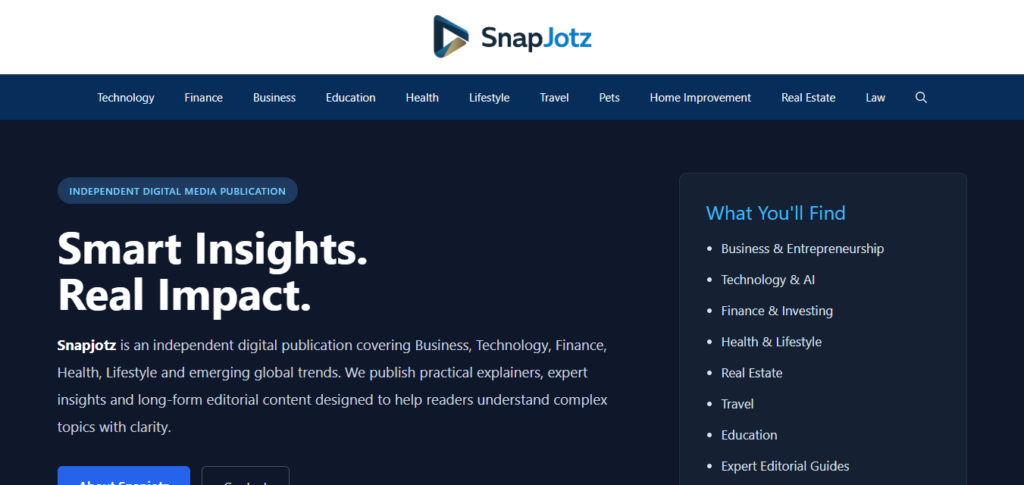
On its own pages, Snapjotz.com presents itself as an independent digital publication covering a wide range of everyday topics, similar to a general-interest blog or online magazine. The homepage describes practical explainers and long-form editorial content on business, technology, finance, health, lifestyle, and emerging trends.
In the pages I reviewed, I did not find sign-up forms, accounts, or tools for posting your own notes. So if you’re looking for a note-taking app or a place to publish short posts, the site itself doesn’t appear to be that.
Snapjotz.com at a Glance
| Question | What the site says or shows |
|---|---|
| What is it? | An independent, multi-topic digital publication |
| Main topics | Technology, finance, business, education, health, lifestyle, travel, pets, home improvement, real estate, law |
| Other categories listed | Automotive, online games, sports, general, uncategorized |
| Self-reported size | 587+ articles, 15 categories, 2 editorial authors |
| Self-reported start | 2023 |
| How it earns money | Digital ads and selective affiliate partnerships, according to its Contact page |
| Policies published | Privacy, editorial, DMCA, terms, legal disclaimers, contact and transparency page |
| Contact | A single email address, with stated weekday hours (9 AM–5 PM EST) and a 24–48 business hour response window |
The size and start-date figures are the site’s own claims. I couldn’t independently confirm them.
What You’ll Actually Find There
Browsing the homepage shows a broad mix. Recent posts include travel advice, health explainers, a guide to multimedia note-taking, a workflow guide for small content teams, a beginner’s guide to generating AI images, and business guides. At least one article is written in German.
A few things stand out:
- Very wide coverage. The site spans topics that usually belong to separate specialist outlets, from orthodontic costs to business strategy to travel planning.
- Posts about the site itself. Several articles use the site’s name in their titles or describe the site (for example, a “complete guide” to the website and its features). That’s unusual for a publication and is probably part of why outside descriptions of it are confusing.
- Two named bylines. Recent posts are credited to two authors. The pages I reviewed didn’t include detailed author bios or credentials.
Why Descriptions Online Don’t Match
Three things explain the confusion.
1. Third-party articles describe a product the site doesn’t appear to offer. Some blog posts say Snapjotz.com lets users create and share short content such as notes, ideas, and quick posts. Those descriptions are generic and don’t match what the site’s own pages show. Treat them with caution, since they may be guessing from the name.
2. Other articles are too vague to be useful. Some pieces talk about the site’s “clarity,” “simplicity,” and role in digital experiences without saying what it does.
3. Similar names exist. Don’t confuse Snapjotz.com with other products spelled “SnapJot” (no “z”). One is a screenshot-annotation browser extension. A much older one was a photo-sharing service from the mid-2000s. They have no connection to this site as far as I could see.
A good habit: trust a site’s own About, Contact, and policy pages first, and treat outside “reviews” with skepticism, especially ones that read like generic descriptions.
How the Site Describes Its Standards
Snapjotz.com publishes an About page and an editorial policy. According to those pages, the process includes:
- Source evaluation: building articles from primary data, peer-reviewed journals, official government portals, and verified corporate reports
- Fact verification: cross-checking statistics, quotes, and technical claims
- Extra care for sensitive topics: finance, health, and real estate content mapped against regulatory benchmarks and professional consensus
- Updates: periodic review of older articles
- Corrections: transparent fixes when errors are reported
- Disclosure: clear labeling of sponsored content and advertising partnerships
- Contributor rules: a stated ban on promotional, deceptive, or AI-generated spam content
Those are good standards on paper. As with any site, the real test is whether individual articles live up to them.
What’s Hard to Verify
Here is what I couldn’t confirm from the pages I reviewed:
- Who owns it. The About page says the site is owned and operated by its “central media division.” I didn’t find a named company, legal entity, or physical address, only an email contact.
- Author expertise. Articles on health, finance, and law are credited to two bylines, but I didn’t see bios or professional credentials on the pages I checked.
- How claims are checked. The fact-checking process is described, but you can’t see it from the outside, and I didn’t see sources listed on the pages I reviewed.
- Timeline. The homepage says the site was established in 2023, while the About and Contact pages were first published in June 2026. That may simply reflect a redesign or migration, but it’s a gap a reader can’t resolve from the site alone.
- Social presence. The Facebook, X, and LinkedIn links in the footer all point back to the site’s homepage, so I couldn’t confirm any active social profiles.
None of these points proves anything is wrong. They’re simply things to keep in mind.
Tips for Reading Snapjotz.com (and Sites Like It)
- Verify before you act on health, legal, or money advice. For anything that affects your health, finances, or legal rights, check it against official sources or a qualified professional. General articles are a starting point, not advice.
- Check the article’s date and sources. Prefer posts that cite primary sources and show when they were last updated.
- Watch for affiliate links. The site says it earns money from ads and affiliate partnerships. Look for disclosure labels near product recommendations.
- Be careful with downloads and pop-ups. As on any ad-supported site, don’t install software or enter personal information because a page prompts you to.
- Don’t expect an app. If you want to take notes or share short posts, use a dedicated tool instead.
- Read the privacy policy. If you plan to comment or email the site, know how your information is handled.
Who Might Find It Useful
- Casual readers looking for beginner-friendly explainers on everyday topics
- Content creators and small teams interested in the site’s guides on workflows, notes, and AI image creation
- Travelers browsing general destination and trip-planning ideas
- Researchers of the web itself, who may find it an interesting example of how multi-topic sites present themselves
It’s less suited to readers who need specialist, credentialed, or news-grade reporting.
Bottom Line
Snapjotz.com is, by its own account, an independent multi-niche publication, not a note-taking app or social platform. It publishes the kind of policy pages readers look for, funds itself through ads and affiliate partnerships, and covers a very wide range of topics. At the same time, ownership, author credentials, and fact-checking details aren’t easy to confirm from the site. Use it as a general starting point, cross-check anything important, and be skeptical of outside articles that describe features the site doesn’t appear to have.